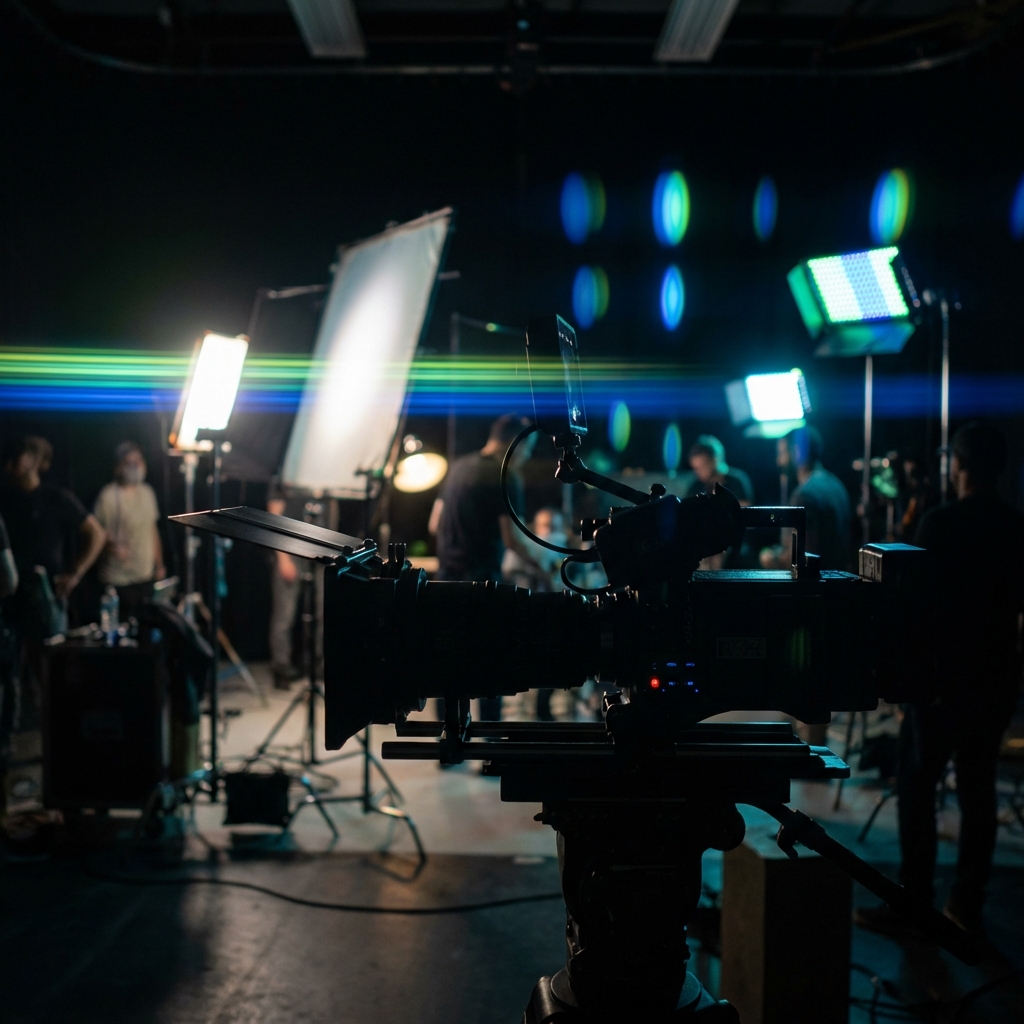
In 2026, the resolution of your camera body is an afterthought. The true differentiator of expensive production is **Lighting Directionality and Texture**. Anyone can point a light at a subject; a master knows how to take light away.
Throughout my years on set, I've noticed that beginners obsess over "brightness." They want to see everything. Professionals, however, obsess over "Darkness." We want to see shape, depth, and dimension. In this guide, we're going beyond the basic 3-point lighting setup and diving into the techniques that define high-end narrative and commercial cinematography in the modern era.
I. SUBTRACTIVE LIGHTING: The Secret Sauce
The most important tool in my kit isn't my $5,000 LED panel; it's my $50 4x4 Solid Black Flag. **Subtractive Lighting** is the process of using negative fill to create contrast. In a typical room, light bounces off every white wall, filling in the shadows on your talent's face and making the image look "flat."
By placing a large black flag on the "shadow side" of your subject, you stop the ambient bounce. This creates a rich, deep shadow that defines the jawline and adds an immediate "cinema" feel to the frame. If you want your work to look like it cost $100,000 to produce, start using negative fill on every single shot.
II. TEXTURE & MOTIVATION: The "Rule of Realism"
Cinematic lighting must always be **Motivated**. This means the light should look like it's coming from a real source in the world (a window, a lamp, a computer screen). Unmotivated light feels like a "studio," which breaks the audience's immersion.
In 2026, we add texture to this motivated light using "Gobos" (Go Between). Placing a plant, a window blind, or even a piece of torn cardboard between your light and your subject creates organic patterns of light and shadow. This breaks up the clinical perfection of digital sensors and gives the image a more "Human-made" and organic texture.
III. RGBWW & COLOR HARMONY: Beyond the Kelvin Scale
The days of just "Daylight" and "Tungsten" are over. Modern LED chips (RGBWW) allow for full HSI (Hue, Saturation, Intensity) control. However, with great power comes the risk of "over-saturated" amateurism.
The Marcus D. 2026 Color Philosophy
I follow the **80/20 Rule**. 80% of my frame is motivated by natural skin tones and neutral Kelvin values (3200K - 5600K). The remaining 20% is where I use saturated "Accent" colors (Teal, Amber, or Magenta) to create color separation. If you saturate the whole frame, nothing stands out.
IV. GLOBAL SHUTTER & LIGHTING DYNAMICS
As discussed in our [Gear Audit], the rise of Global Shutter sensors has changed how we light for motion. Since there is no rolling shutter "skew," we can now use ultra-fast, high-frequency strobes and flickering LED effects (like a passing police car or a glitching screen) with perfect synchronization.
Using DMX-controlled lighting rigs allows us to sync our light cues directly with the camera's shutter. This "Computational Lighting" is the future of high-speed action and music video production.
V. LIGHTING FOR VIRTUAL PRODUCTION
When working in an LED Volume (Virtual Production), the lighting on your talent must perfectly match the lighting in the digital environment. We use **Image-Based Lighting (IBL)**, where the LED walls themselves act as the light source, casting the same colors and reflections onto the subject that the virtual world would.
This "Real-time Reflection" is why virtual production looks so much more realistic than traditional green screen. As a modern DP, you must understand how to blend physical Arri Skypanels with the digital light coming from the Unreal Engine volume.
Download the 2026 Lighting Manifesto
Get our full DMX-routing guides and on-set lighting diagrams for high-end commercial builds.
View Rate Reports